
How to Multiply Strawberry Plants

If you love strawberries, then growing them in your garden is a wonderful idea. Once you buy a few plants, you can propagate them without much effort.
Multiplying all the strawberry plants that produce runners is easy and completely free. This is something I love doing in my own garden. It is very rewarding to grow a collection of plants and maybe even have extra plants to hand out to family or friends.
What are strawberry runners?
Strawberry runners are stolons, or horizontal stems, that grow from the base of many strawberry plants. Most strawberry varieties that produce June and always produce stolons as a means of propagation.
Nodules form on these stolons, followed by adventitious roots (which are roots that grow in places like stems or leaves).
These roots will grow, and when they come into contact with the soil or other suitable growing medium, new strawberries will form at these points. The new strawberry trees will be clones (genetically identical) of the parent they grew up from.
Driving strawberry runners
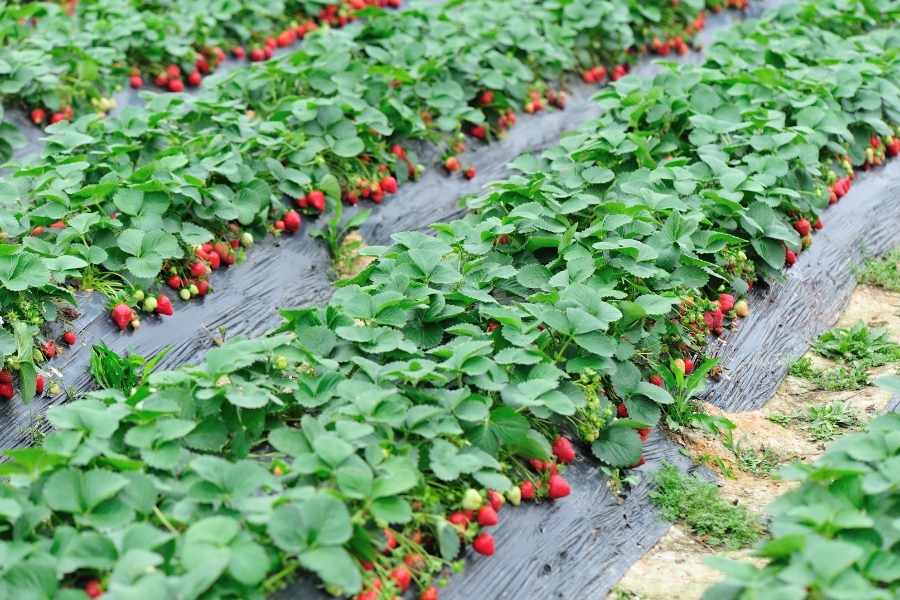
If you let a strawberry patch grow naturally, the corridors will spread out in all directions and eventually create a dense matted strawberry patch, with new plants popping up randomly among the older ones.
Alternatively, you can target runners to make your life easier. If you are growing strawberries in the ground in a typical bed, you can route runners from one row of strawberries to a second, orderly row.
This makes sense because it's easier to track the age of strawberry plants and remove older plants after three to five years, when they become less productive.
Another option, whether you're growing strawberries in the ground or in containers, is to direct the strawberry runners to new pots. The advantage of this is that you can easily move the new strawberry plants to a new area of your garden or give them away for free.
Picking up or weighing strawberry runners
Once you've decided where you want your new strawberry trees to grow, you should make sure that a stoler's node is in contact with the soil or growing medium.
To keep runners in contact with the ground in a given location, there are several solutions. I like to use recycled or natural materials.
For example, you can use branched branches with a section on each side of the aisle or branches curved in a U-shape and inserted into the ground.
You can use two thin stones with a larger stone placed on top to hold the runner in place. Other ideas include using a bent piece of wire, an old tent stake, or an upside-down clothing gift.
Be careful not to crush the hallway. Remember that nutrients and water will need to travel along this channel from the parent plant until the new plant's root system is established.
Taking care of strawberry runners and new strawberry plants
Remember to water the existing strawberry plants and new ones at the end of the channels as they form. It shouldn't take long for the new plants to form strong, healthy root systems.
Once they have rooted well, the connecting channels should naturally die and break the connection with the mother plant. If you don't want to wait that long and want to move your new plants a little earlier, you can cut the stolons as soon as the new roots form.
If you remove the stake or other structure that holds the channel down and the plant does not easily lift off the surface of the soil or growing medium, it means that roots have formed and you have successfully propagated new strawberry plants.
Some strawberry seeds need a cool period to germinate. If you have this type, put them in the freezer for a few weeks before taking them out, allowing them to warm to room temperature before sowing. Seeds germinate at temperatures between 65˚F and 70˚F (18-21˚C). Seedlings should appear in about two to three weeks.
Enjoy This Video Tutorial About How to Multiply Strawberry Plants
Source: Learnagro - Deepak Bhandari
Did you find this post Useful or Inspiring? Save THIS PIN to your GARDENING Board on Pinterest! 😊
Once again, thank you for visiting our website!
We hope you've enjoyed exploring the content we've created for you.
Give yourself the chance to learn, get inspired, and have even more fun, keep browsing...
More Gardening Tips 👇🏼👇🏼