
Sarnath: The Complete Guide

The place where the Buddha delivered his first sermon
Sarnath (along with Bodhgaya and Kushinagar in India and Lumbini in Nepal) is one of the four major Buddhist pilgrimage destinations in the world.
It has a special meaning because it is the place where the Buddha delivered his first sermon.
However, you don't have to be a Buddhist to enjoy your visit. Sarnath also makes a peaceful and refreshing journey from Varanasi.
Many people are surprised to find that Sarnath also has connections to Jains and Hindus.
We hope you enjoy watching this video about Exploring Sarnath, Travel Guide

Source: Being MANU
Find out what you need to know to visit in this guide!
History
Long ago, around the 5th century BC, a young prince named Siddhartha Guatama was born in Lumbini.
He led a very sheltered and luxurious life. However, shortly before he turned 30, he ventured into the countryside, where he encountered illness and death.
This led him to give up everything and go in search of freedom from suffering.
He finally realized that liberation comes from disciplining the mind. He then sat in meditation under a sacred fig tree and decided not to get up until it was enlightened.
It happened, deeply, on a full moon night. The tree (which came to be known as the Bodhi tree as a reflection of his awakening) was located on the site of the magnificent Mahabodhi temple in Bodhgaya.
The Buddha, however, did not start preaching at Bodhgaya.
There were five people he wanted to teach first. He had already practiced physical discipline with them as a means of liberation.
They upset him after he decided it was not the right path to liberation. The Buddha heard that they lived in a deer park in Sarnath, so he went there.
They were so impressed by his new wisdom and the Four Noble Truths that they became his first disciples.
Buddhism flourished in Sarnath due to its proximity to Varanasi.
However, most of the structures were built by the Mauryan Emperor Ashoka a few centuries after the religion was established.
Guilt for his brutal invasion of Kalinga (now Odisha on the east coast of India) caused him to convert to Buddhism and the practice of non-violence, and he began enthusiastically building stupas and pillars throughout India to promote the religion.
The most famous pillar is that of Sarnath. The national emblem of India, with four lions and a dharma chakra (wheel representing Buddhist teachings), is derived from it.
Chakra also appears on the Indian flag.
Later rulers expanded the stupas and monasteries that Ashoka built at Sarnath.
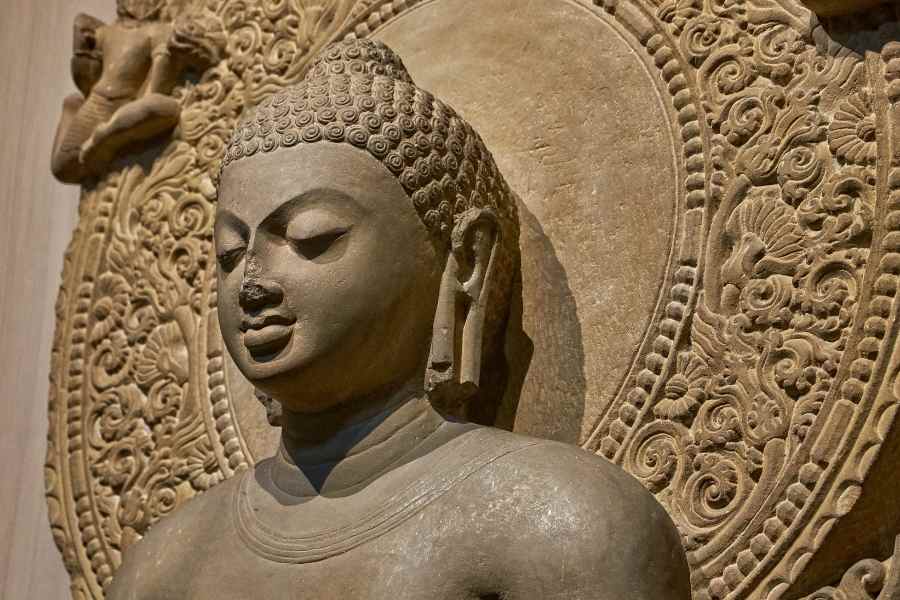
During the reign of the Gupta dynasty in the 4th century AD, Sarnath was an active center of Buddhist art and sculpture.
By the 7th century, Sarnath had become an important center for the study of Buddhism, and thousands of monks lived in the monasteries there.
Unfortunately, Muslim Turkish invaders arrived in the 12th century and destroyed much of Sarnath, along with many other Buddhist sites in northern India.
Most of what was left of the Dharmarajika stupa, made by Ashoka, was demolished in the late 18th century by Jagat Singh (Dewan of Raja Chet Singh of Banaras) and used as a building material. However, this rediscovery of Sarnath led British archaeologists to excavate the site in the 19th and 20th centuries.
The Indian government is now in the process of permanently listing Sarnath as a UNESCO World Heritage Site and has plans to develop world-class facilities for pilgrims and tourists.
Location
Sarnath is located approximately 13 kilometers (8 miles) northeast of Varanasi in Uttar Pradesh. Travel time is about 30 to 40 minutes.
How to Visit
Sarnath can be easily visited on a half-day trip from Varanasi. There are several ways to get there, depending on your budget.
The most convenient way is to take a rickshaw or Ola taxi (the Indian version of Uber. Uber has not yet started operating in Varanasi).
Expect to pay around 200-300 rupees for an automotive rickshaw and 400-500 rupees for a one-way taxi. Ideally, negotiate the fare for a round trip.
There are also cheaper buses and shared rickshaws from Varanasi Junction train station.
If you don't have your own transport in Sarnath, it's a good idea to rent a bike there to see it all.
For a detailed explanation of the history of the monuments, you will find many local guides waiting in Sarnath.
They charge around 100 rupees or less if you agree to visit the stores where they will receive a commission.
Alternatively, Varanasi Magic offers a half-day tour of Sarnath.
The Indian Railways Mahaparinirvan Express Buddhist Circuit Train Special Train also includes Sarnath on its itinerary.
Avoid visiting Sarnath on Fridays as the museum is closed. Some of the monuments require tickets, which can be purchased online at the Archaeological Survey of India here or at the ticket office at the entrance.

What to See There
The main attraction is the Dhamekh Stupa Complex, where the excavated ruins are located.
It is situated in a landscaped park and contains the well-preserved Dhamekh stupa (where the Buddha reportedly delivered his first sermon), as well as the remains of Buddhist monasteries, the Pilar Ashoka and Dharmarajika stupa.
The complex is open daily from dawn to dusk. Tickets for foreigners cost 300 rupees (cash) or 250 rupees (no cash).
Indians pay 25 rupees (cash) or 20 rupees (no money).
A new high-tech sound and light show, which opened in November 2020, takes place every night starting at 7:30 p.m. at 20:00 in the park of the Dhamekh stupa.
It narrates the life and teachings of Lord Buddha with the charming baritone voice of popular Bollywood actor Amitabh Bachchan.
Interesting artifacts dating back to the 3rd century BC are exhibited at the attractive Sarnath Archaeological Museum, next to the Dhamekh stupa complex. C. to the twelfth-century d. C.
The impressive summit of Ashoka Pilar is also a highlight. The museum is open every day except Friday from 9 am to 5 pm Tickets cost 5 rupees for foreigners and Indians.
Photography is not allowed.
Modern temples and monasteries belonging to various Buddhist countries are scattered around the city.
Each has its own architectural style and beauty. The main one is Mulagandha Kuti Vihar. It was built in 1931 by the Sri Lanka Mahabodhi Society, in honor of the shrine where Buddha sat and meditated at Sarnath.
It is open every day from 4:00 a.m. M. At 11:30 a. M. And from 1:30 p. M. At 8:00 p.
The walls are adorned with magnificent works of art. There is a park behind him where deer sometimes roam.
The Thai temple and monastery is known for its 24-meter-high stone Buddha statue, considered the largest in India.
The Chaukhandi Stupa is another large stupa that is in relatively good condition. Mark the place where the Buddha met his five companions.
The Archaeological Survey of India began maintaining the site.
There is now an entrance fee of Rs 300 (cash) or Rs 250 (cashless) for foreigners and Rs 25 (cash) or Rs 20 (cashless) for Indians.
Alongside the Chaukhandi Stupa, the Garden of Spiritual Wisdom is a new attraction with sculptures and exhibits related to Buddhism.
It also has a section with Ayurvedic plants.
The eleventh Tirthankara (spiritual master) Jain Shreyanshnath was born in the region.
There is an important 19th-century Jain temple dedicated to him near the Dhamekh Stupa complex.
What Else to Do nearby
The town of Lamhi, about 30 minutes west of Sarnath, is the birthplace of the acclaimed Hindi and Urdu writer Munshi Premchand.
There you can visit cattle farms and agricultural fields.
Sarai Mohana village, about 20 minutes south of Sarnath, is home to a local community of weavers who make the famous Banarasi silk saris.
Did you find this post useful or inspiring? Save THIS PIN to your Travel Board on Pinterest! 😊

Once again, thank you for visiting our website!
We hope you've enjoyed exploring the content we've created for you.
Give yourself the chance to learn, get inspired, and have even more fun, keep browsing...

You may also like 👇🏼👇🏼