
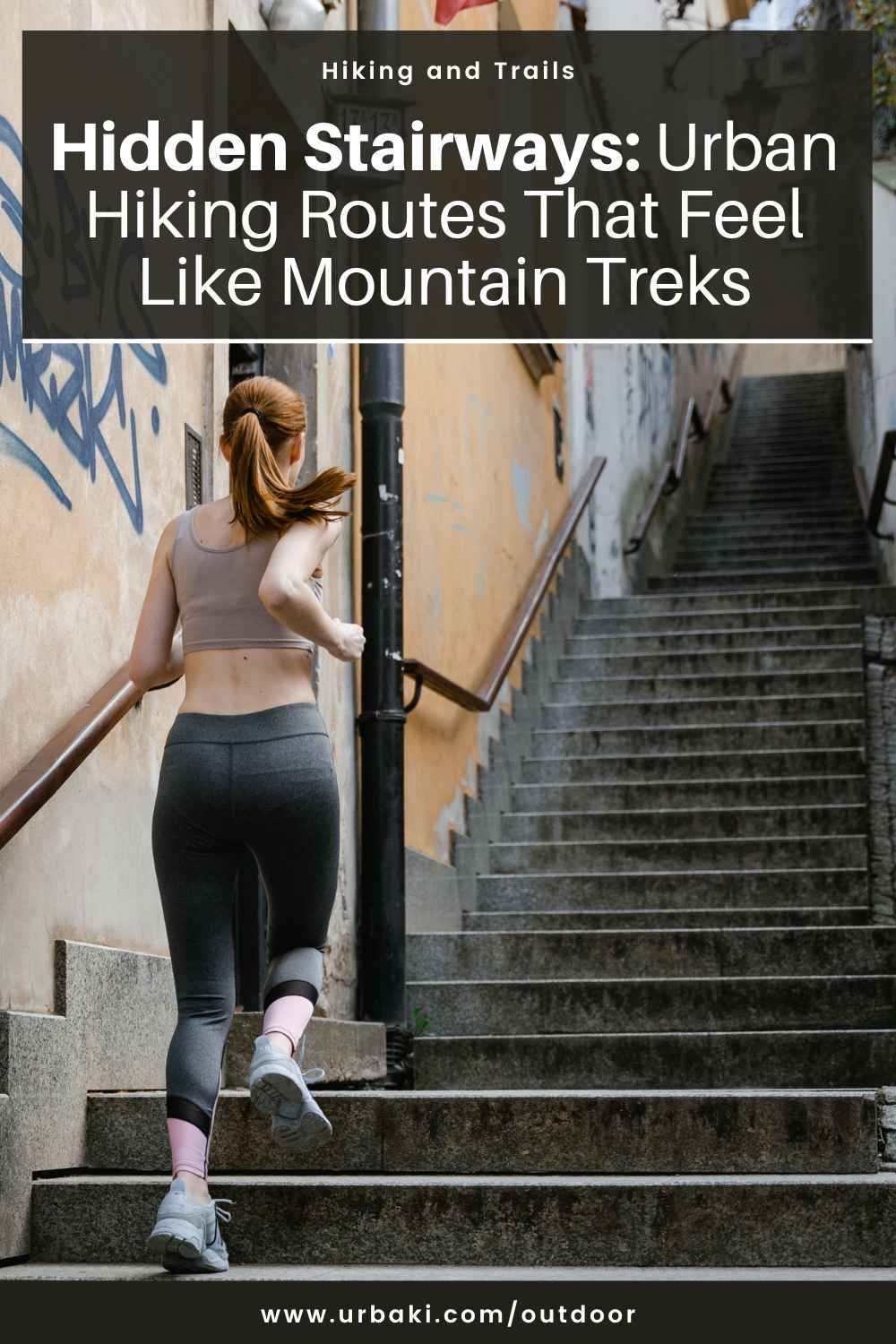
Hidden Stairways: Urban Hiking Routes That Feel Like Mountain Treks

If you’ve ever craved ridge-line views and quad-burning climbs but only had an hour between errands, urban stairways are your secret trailheads.
These tucked-away steps—running up hillsides, slicing through neighborhoods, ducking behind parks—deliver real elevation gain, continuous cardio, and surprising scenery without leaving the city.
The magic is in the rhythm: short, steep pushes followed by small landings that mimic the switchbacks and pitches of a mountain trail. Add in murals, pocket gardens, and skyline vistas, and you get a compact adventure that feels bigger than the map suggests.
How to Find Hidden Stairways in Any City
Start with the contour lines of your town. If you have hills, you have steps. Scan satellite and terrain views for tight elevation lines, then look for thin pedestrian connectors.
Search neighborhood groups or city planning pages for terms like “public steps,” “stair streets,” or “walking connectors.”
Parks that border steep streets often hide staircases between terraces, and older neighborhoods commonly keep stair lanes linking transit stops to ridge streets.
Walk with curiosity. That narrow gap between fences? It may be a legal right-of-way. A block of houses perched high above an avenue? There’s likely a hidden stair cutting up the slope.
Ask dog walkers, postal carriers, and gardeners—locals are the best beta for quiet, safe, well-maintained sets.

Build a Route That Climbs Like a Trail
Think in segments the way you would plan a mountain hike—approach, ascent, ridge, descent, finish. String together three to five stairways with short street connectors and you’ll have a loop with varied grades that keeps the heart rate honest.
Route Style 1: The Climbing Loop
Pick one “main” staircase with 150–300 steps as your summit push. Approach it on a gentle incline, climb to a view street (the ridge), recover with a flat block or park bench, then drop down a different stair to close the loop. Two laps turn this into a legit training session.
Route Style 2: Out-and-Back Intervals
If you only have one stairway, you still have a workout. Do 3–5 repeats with different focuses: steady pace, double-step power, side-step agility. Use the landing at the top for 30–60 seconds of recovery before descending under control.
Route Style 3: The Ladder
String a short set → medium set → long set so each climb is bigger than the last. Treat the longest stairway as your summit, then unwind the ladder in reverse to return to your start.

Training Benefits You Actually Feel
Urban stair routes aren’t just novel—they’re efficient. Climbing steps taxes the glutes, quads, calves, and core in ways that flat running can’t, while the constant up-down movement builds eccentric control that protects your knees on real descents.
Because stairways compress elevation into small distances, you can notch meaningful vertical gain in 30–45 minutes. Add a daypack with water and a wind layer for functional load that simulates the feel of a mountain day without the travel time.
For data lovers, track vertical feet instead of miles. Roughly speaking, one standard floor ≈ 10 feet of climb; a 200-step stair might net 120–150 feet depending on riser height. Stack a few sets and you’ve earned your summit snack.
Safety, Courtesy, and Flow
City steps are shared spaces. Keep the experience friendly and sustainable with a few habits:
- Yield with a smile on narrow segments and step aside for people moving faster or carrying loads.
- Watch footing on wet leaves, painted edges, or mossy patches, especially in shade.
- Respect neighbors: speak softly at dawn/dusk, avoid blocking doorways, and don’t blast music.

- Carry the basics—water, ID, small light—because urban doesn’t always mean easy.
- Know your exit options: many stairways connect to multiple streets; note shortcuts in case of fatigue or weather.
Four Sample Circuits to Spark Ideas
These mini-itineraries illustrate how to shape a route. Use them as templates and swap in the stairways where you live.
The “Garden-to-Ridge” Circuit
Begin at a small community garden or pocket park at the base of a hill. Climb a medium stair (100–200 steps) to a ridge street lined with older architecture.
Recover by strolling one block along the ridge, then descend a scenic stair painted with murals. Repeat twice, aiming for even pacing on each ascent.
The “Waterside to Overlook” Push
Start near a river, bay, or canal path. Warm up for 10 minutes on the flat, then attack a long continuous stair that rises to a viewpoint or overlook.

Celebrate the top with slow breathing while you take in the skyline, then descend carefully and jog the waterfront back to your start.
The “Historic Steps Sampler”
Pick a neighborhood known for steep streets. Connect three different stairways—one narrow and leafy, one wide and formal, one tucked behind buildings.
Focus on cadence control: climb the first at conversational pace, the second with double steps every 3–4 risers, and the third as a steady grind.
The “Sunset Switchbacks”
Time your loop to catch golden hour at the highest landing. Bring a compact headlamp for the descent and keep speeds modest. City lights below you can feel as awe-inducing as alpine alpenglow.
What to Pack (and Wear) for Urban Treks
You don’t need much, but a few choices make a big difference. Grippy low-profile trainers help on steep descents. A small pack carries water, a light wind layer, and a snack; even a soft flask is enough for short sessions.
If your route explores shady lanes, toss in a mini flashlight. On cooler days, breathable layers beat heavy cotton—stairs are heat engines.

Turn Stairways Into a Weekly Habit
Consistency turns hidden steps into your favorite training ground. Try this four-week progression:
- Week 1: Two sessions. 20–25 minutes each at easy effort, exploring and mapping stair options.
- Week 2: Two sessions. 30–35 minutes with 3 × 2-minute climbs at moderate effort. Walk recoveries.
- Week 3: Two to three sessions. One interval day (4 × 2–3 minutes uphill), one steady loop (continuous 30–40 minutes), one optional technique day (double steps, side steps, controlled down-climbs).
- Week 4: One longer loop—45–60 minutes—linking three or more stairways with calm, sustainable pacing.
Track your vertical gain, not just time. The moment you notice descents feeling smoother and climbs feeling steadier, you’re harvesting true trail-ready strength.
Designing Routes with Character
Great stairway routes have personality. Maybe it’s the art—tiles, mosaics, painted risers—or the soundtrack of city life shifting as you rise from markets to quiet terraces. Perhaps it’s a smell map: bread near a bakery, eucalyptus on a windy landing, jasmine over a fence.
Build this texture into your loop. Add a “micro-objective”—touch the highest lamppost, count the last ten steps aloud, or write a one-line note in your phone describing the view. These rituals give your urban hikes the sense of arrival that mountain summits create.

Weather, Seasons, and Timing
Hot day? Chase shade-heavy stairs and north-facing lanes, and go early. Rainy afternoon? Seek wider steps with good drainage and avoid painted stripes.
Winter light can be exquisite; just mind slippery leaves and dusk. If crowds are thick, treat that as a pacing tool—patience is training too.
Bring Friends, Build Community
Urban stairways make social hiking simple: easy to reach, short commitment, and plenty to talk about along the way. Start a weekly stair circle with neighbors, rotate who chooses the loop, and cap the outing with coffee or a park stretch.
Share your route map so others can enjoy it—and if you come across a broken handrail or damaged step, report it to the city so these passages stay safe and open.
Your City, Your Summit
You don’t need a trailhead sign to find adventure. With a curious eye and a little planning, hidden stairways become your personal peaks: compact climbs with big-day energy, stitched right into the neighborhoods you love.
Lace up, pick a starting step, and let the city lift you—one riser, one landing, one satisfying view at a time.
Did you find this post useful or inspiring? Save THIS PIN for later in your Outdoor Board on Pinterest! 😊
Explore these outdoor tips too